
The $5,000 Commercial That Built a $340 Million Water Brand
How a graphic designer at a punk concert built a beverage company before the product existed

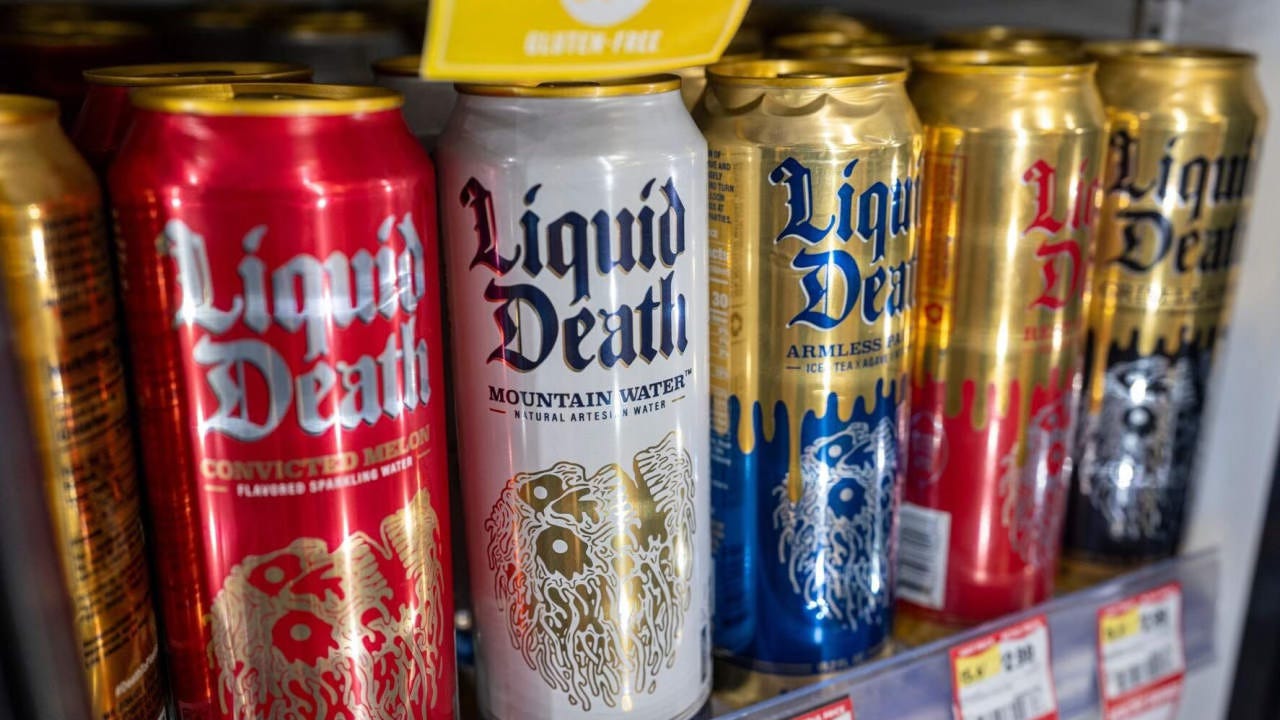
Mike Cessario was a graphic designer at a Los Angeles advertising agency in 2009 when he went to a Vans Warped Tour and watched kids in the punk pit drink water out of Monster Energy cans. Nobody in the pit wanted to be seen with a plastic Aquafina. The water companies had the product. The energy drink companies had the identity.
Cessario went home and sketched a label. He kept the idea in a notebook for eight years and kept working in advertising. He filed the Liquid Death trademark in 2017. In 2018, before he had a product to sell or a can to put it in, he spent $5,000 making a fake commercial. His wife’s friend modeled the can for a thousand dollars. Another friend lent him a camera for two hundred. He shot the spot over a weekend in someone’s empty downtown LA office. He used a Miller Lite can angled out of frame, because Liquid Death didn’t have its own can yet. He put a few hundred dollars of paid Facebook spend behind the video and waited.
The video racked up 3 million views and 80,000 Facebook followers. That was more followers than Aquafina had at the time, for a brand whose product didn’t exist.
Eight years after the commercial, Liquid Death is generating roughly $340 million a year and was last valued at $1.4 billion. The model worked until 2025, when growth stopped. In January 2026, Cessario launched Sparkling Energy and ran a Super Bowl ad to promote it. The launch is the test of whether the same model that built the water company can scale into a $23 billion category dominated by Red Bull and Monster.
Mike Cessario is still the CEO. He built one of the best-known consumer brands of the last decade without a salesforce, a truck network, or a strategic distribution partner. The Sparkling Energy launch is going to answer whether that same approach holds when the cooler at the front of the c-store belongs to Coke and Pepsi.
Part One: From a Concert Pit to Walmart Aisles
Liquid Death shipped its first product in 2019. Cessario had three co-founders by then, including a bartender and an artist. The cans were manufactured in Austria, where a partner sourced still mountain water and packaged it in 16.9-ounce aluminum tallboys. The Series A had closed earlier that year. Velvet Sea Ventures led $9 million into the company. Total funding to date was around $11 million.
The early traction came through direct-to-consumer e-commerce and a handful of specialty retailers. Skate shops, music venues that did their own buying, a few independent grocers. Then the pandemic hit in March 2020. Concerts and bars and gyms all shut down, and the on-premise channels Cessario had been counting on disappeared. Liquid Death leaned into the website and let the social channel keep building.
In May 2021, Cessario closed the deal that turned Liquid Death from an indie brand into a national one. Live Nation Entertainment operates most of the amphitheaters and arenas where concerts happen in North America. The company signed an exclusive agreement with Liquid Death and participated in the Series C round, making Liquid Death the only water sold at its venues. The Series C raised $15 million. The distribution it unlocked was worth more.
The retail expansion followed. Whole Foods rolled the cans out nationally that year, and 7-Eleven, Target, and Walmart followed across 2021 and 2022. In October 2021, the company raised another $75 million at a $500 million-plus valuation. Revenue that year hit $45 million.
Cessario didn’t have a salesforce pitching those chains. The buyers had already seen the TikTok and Instagram numbers grow on their own. They’d already heard customers asking for the cans at smaller stores. By the time Cessario’s team sat down with a buyer, the question wasn’t whether to stock the product. It was how many SKUs and which shelf.
The growth from there was the fastest stretch in the company’s history:
2021: $45 million
2022: $110 million
2023: $263 million
2024: $333 million
Sparkling water flavors got added in 2021 and 2022, then iced tea. Still water dropped to less than half of the product line. The dark humor and skull-and-crossbones aesthetic stayed.
In March 2024, the company raised $67 million at a $1.4 billion valuation. The investor list included institutional funds like PowerPlant Partners and SuRo Capital alongside celebrity money from Tony Hawk and Wiz Khalifa. Goldman Sachs had been hired in July 2023 to prepare Liquid Death for an IPO. The IPO was supposed to happen in spring 2024.
Note from a CFO: Liquid Death’s $1.4 billion valuation in 2024 was more than four times its $333 million in revenue. For a private beverage company, that’s a steep revenue multiple. Established beverages like Coca-Cola and PepsiCo trade at two to five times revenue, and they have decades of stable cash flow behind them. The premium investors paid for Liquid Death was a bet that Cessario’s marketing engine would keep growing the company fast enough to justify the price. The 2025 numbers were going to test that bet directly.
A graphic designer with a $5,000 commercial had built a beverage company valued higher than most public competitors of similar revenue. Every other water brand sold clean and healthy. Liquid Death sold skull cans and dark humor. He’d built a billion-dollar beverage company without the trucks or the sales reps.
Part Two: The 2% Year
The IPO never happened. The market for new offerings stayed quiet through 2024, and by the end of the year Liquid Death was still private. The bigger problem was that the underlying business stopped growing.
Revenue went from $333 million in 2024 to roughly $340 million in 2025. Around 2 percent. Sales on liquiddeath.com fell sharply. The website is where the most enthusiastic customers buy. They see a TikTok and order a 12-pack the same day. Those people drove the first $340 million of revenue. They heard about the brand first, told their friends, and refilled their fridges constantly.
By 2025, most of them had already done that. They weren’t going to buy more water from the same company at the same rate. The drop in website sales wasn’t a fluke. The early customers had hit their ceiling. The brand wasn’t done. But the growth had to come from somewhere else. The next customers don’t already love the brand, don’t watch the TikToks, and would have to be reached some other way.
In June 2025, the company raised $20 million in a convertible note. A convertible note is a loan that turns into stock at the price of the company’s next funding round. Companies use them when they need cash but don’t want to set a new stock price today. Liquid Death’s previous stock price was set in March 2024 at $1.4 billion. By mid-2025, the market wasn’t likely to give them that number again. The convertible let them get the cash without testing the question.
Note from a CFO: A convertible note signals what the price tag doesn’t. That price was set in March 2024 by a small group of celebrity and institutional investors with strong incentives to say yes. When the company needed cash again fifteen months later, no new investors stepped up to back that number. The convertible was the workaround.
In October 2025, Liquid Death hired Ricky Khetarpaul as Chief Financial Officer. He had spent more than two decades in beverage and food finance, including a stretch at PepsiCo running the financials for a $5 billion beverage portfolio. Most recently he had run Health-Ade Kombucha through its sale to Generous Brands as the company’s CFO. He’s the kind of CFO companies hire when they’re getting ready to either go public or sell.
The same month, Liquid Death signed its first deal with a traditional beverage distributor. Big Geyser is the largest beverage distributor in the New York metro area, with its own truck network running to thousands of bodegas, delis, and c-stores. It was the first time Liquid Death had used outside distribution help. Marketing alone wasn’t going to be enough anymore.
Part Three: Stop Exploding
In January 2026, Liquid Death launched Sparkling Energy. The cans went onto the same Walmart and Target shelves where the water already sold.
On February 8, 2026, three weeks after the launch, Liquid Death ran its second consecutive Super Bowl ad. The spot was called “Stop Exploding” and promoted Sparkling Energy. A single 30-second Super Bowl slot in 2026 cost roughly $8 million. That was more than Liquid Death’s entire marketing budget in its first year.
On paper, the energy drink bet made sense. The U.S. category is worth $23 billion. The margins are higher than in premium water. Liquid Death is more visible than it has ever been, with 14 million followers across TikTok and Instagram and a 2025 Super Bowl ad that was one of the most-engaging of the game.
The early signal was strong. Sparkling Energy captured 1.1 percent of the energy category on Amazon in its first week with just four SKUs, and Liquid Death says it has held that position since.
But energy drinks are not water.
In water, every other brand was selling clean and healthy. Liquid Death sold skull cans and dark humor. Energy drinks are the opposite. Every brand competes on identity. Red Bull on extreme sports. Monster on aggressive masculinity. Celsius on wellness.
That’s only half the problem. The other half is where energy drinks are bought.
At lunchtime, a customer walks into a 7-Eleven, opens the cold case, and picks a can in 30 seconds. Whatever’s at eye level wins. Red Bull and Monster sit there because Coca-Cola’s and PepsiCo’s trucks deliver to those coolers every week. Their sales reps restock the shelves and lock in the placement. That real estate gets paid for store by store, by a salesforce with relationships that go back decades.
Sparkling Energy is not in that cold case. It’s on the Walmart and Target shelves where the water sells. Walmart and Target are where someone goes to buy a 12-pack for the week, not where someone grabs a can on the way back to work. The launch landed on shelves where Liquid Death already had a position. The shelves where energy drinks are actually bought weren’t on the list.
Celsius solved this exact problem in 2022. PepsiCo paid Celsius Holdings $550 million for a roughly 8.5 percent stake and became the company’s primary distributor. Celsius scaled from $75 million in revenue in 2018 to roughly $1.4 billion in 2024. BodyArmor went a different route. Coca-Cola bought the brand outright in 2021 for $5.6 billion.
Liquid Death hasn’t made either trade yet.
Part Four: Six Lessons from a Brand Built on $5,000
Lesson 1: You can build an audience before you build a product. A company doesn’t need a finished product to start finding out whether customers want it. Cheap social content can prove people want something before it exists. That makes finding customers and raising money easier when the product is real. Cessario built an 80,000-follower brand with a $5,000 fake commercial in 2018, using a Miller Lite can as the stand-in. The audience he built that weekend funded the launch the next year.
Lesson 2: When every product is the same, what gets picked is the one that looks different. Every water brand hydrates the same. Every salt brand seasons the same. The competition stops being about function and starts being about how the product looks on the shelf. Every other water brand sold clean and healthy. Liquid Death sold skull cans and dark humor.
Lesson 3: Constraints often produce better work than money does. Founders often wait to launch until they have the perfect setup, with a finished product, polished marketing, and a real budget. The waiting is usually a mistake. Cessario didn’t have access to the beverage distribution networks Coca-Cola and PepsiCo had built. So he signed Live Nation in 2021 and turned every major concert venue in North America into Liquid Death’s first store.
Lesson 4: When customers ask retailers for your product, you don’t need a salesforce. Traditional consumer brands hire salesforces to convince retail buyers to stock their products. When customers are already asking for a product, the retailers come to the company instead. The demand at smaller stores does the pitching, and the salesforce stops being necessary. Liquid Death never built a national salesforce. Whole Foods, 7-Eleven, Target, and Walmart picked up the cans because customers were already asking for them.
Lesson 5: A brand can only carry a company so far on its own. A strong consumer brand can get a product to a few hundred million in revenue on customer demand alone. Past that, the math changes. Without a national distribution partner, the brand hits a wall. Liquid Death hit that wall in 2025. The brand had built a $340 million business on cultural pull alone, then growth flatlined because there were no new customers to find that the marketing could reach.
Lesson 6: Putting a product on shelves is not the same as competing in a category. Liquid Death’s sparkling water and iced tea extensions worked because they sat next to water in the same aisle. The buyer was the same. The channel was the same. Sparkling Energy is on Walmart and Target shelves too, but energy drinks aren’t bought in those aisles. They’re bought at the cold case in convenience stores, where Red Bull and Monster control the placement.
The Verdict
Seventeen years ago, Cessario watched kids at a Warped Tour pick Monster Energy cans over water bottles. His bet was that loud enough marketing could replace what the beverage industry had spent a hundred years building.
The bet worked. Liquid Death sells in more than 113,000 retail outlets, built one of the most-recognized consumer brands of the decade, and ran two consecutive Super Bowl ads. Sparkling Energy now sits next to the original Liquid Death water on shelves at Walmart and Target.
But the marketing can’t put a can in front of a customer at the cold case at the front of a 7-Eleven. That’s where energy drinks are bought. That real estate belongs to Red Bull and Monster, with Coca-Cola and PepsiCo behind them.
The cooler belongs to Coke and Pepsi. The only way Cessario gets in is to trade equity to a distributor or sell the company.
Where in your business does the next chapter require what the last chapter proved you didn’t need?
If you enjoyed this breakdown, share it with someone who appreciates the business side of things, or subscribe for the next one.