
The Retail Business Model That Breaks Every Rule (And Makes $1.1B Doing It)
How Spirit Halloween turned extreme seasonality into a competitive advantage

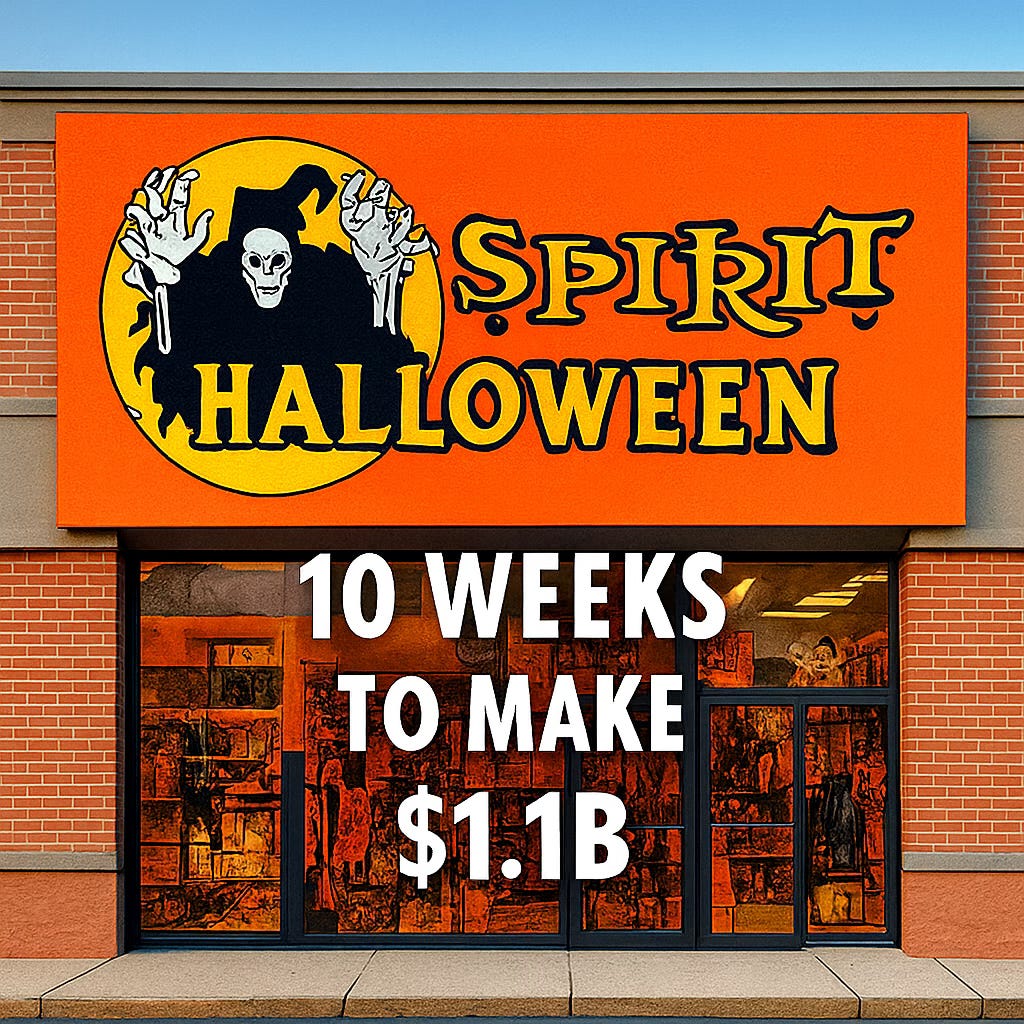
Spirit Halloween generates $1.1 billion in revenue — but only operates 10 weeks a year.
Most retailers spread revenue across 52 weeks, carefully managing inventory and cash flow throughout the year. Spirit Halloween concentrates 90% of annual sales into a single quarter. Even more extreme: 70% of their entire year happens in the final two weeks of October. Miss that window, and the year is lost.
This should be impossible. Every finance principle says extreme revenue concentration equals fatal flaw. Diversify revenue streams. Smooth seasonality. Avoid concentration risk. Build year-round customer relationships.
Yet Steven Silverstein, CEO for 22 years, built a billion-dollar empire around this “flaw.”
Under his leadership, Spirit Halloween grew from roughly 400 stores in 2003 to a record 1,525 locations in 2024. They captured 30% of the specialty Halloween retail market while competitors collapsed. When Party City slashed its Halloween City pop-ups by 91% during COVID (from 250 stores to just 25), Spirit opened 1,400 locations and kept growing.
The company operates with negative working capital during peak season. They achieve operating profit margins above 20%. They reuse 30-40% of inventory annually. Each store requires minimal capital investment yet generates $721,000 in revenue over 90 days.
This is how Spirit Halloween engineered a business model that defies retail gravity. Spirit Halloween operates as a privately held company within Spencer Spirit Holdings, which means detailed financials aren’t publicly disclosed. The analysis that follows draws from credit rating agencies like Moody’s, industry reports, trade publications, and company statements to piece together how the economics actually work.
The Working Capital Magic Trick
Here’s the nightmare scenario on paper: Spirit orders inventory from Asian manufacturers in January and February — a full six to nine months before selling a single costume. Those containers arrive at their Charlotte, North Carolina distribution center throughout the summer. Peak imports hit in July and August. In 2024 alone, Spirit imported 33,098 shipping containers from Asia, up 18.6% from the prior year.
Meanwhile, the cash register stays silent.
No revenue in January. No revenue in February, March, April, May, June, July. The company burns cash paying for inventory, distribution operations, real estate teams, designers, and corporate overhead — all while generating zero retail revenue for nine straight months.
Then stores open in late August. The clock starts ticking. Spirit has exactly 90 days to convert nine months of spending into a year’s worth of revenue. The pressure intensifies as October approaches, because 70% of annual revenue arrives in the final two weeks before Halloween.
Most businesses would suffocate under this cash flow pattern. Spirit engineered something different.
Here’s the genius: suppliers operate on standard payment terms of 30 to 60 days after delivery. Inventory arriving in August and September means supplier payments come due in October and November — exactly when Spirit’s revenue floods in from peak Halloween sales.
The company receives customer payments before paying suppliers.
This creates negative working capital during their most critical period. It’s not financial engineering or aggressive vendor arm-twisting. It’s operational design that aligns international supply chain timing with seasonal demand patterns. Most retailers fight against their cash conversion cycles. Spirit designed operations so the cycle works in their favor.
The distribution strategy amplifies this advantage. Unlike traditional retailers managing continuous replenishment, Spirit has one massive deployment in August-September, followed by just one or two resupply deliveries during the season. The entire store — fixtures, merchandise, point-of-sale systems — arrives in a single truck.
During peak season, their Charlotte distribution center transforms. The year-round staff of 200 employees scales to over 500 associates working two shifts. Conveyors spanning 2.5 miles process inventory for 1,525 stores simultaneously.
But here’s the most underappreciated financial advantage: Spirit reuses 30% to 40% of inventory year-over-year. After stores close in early November, unsold merchandise returns to distribution centers. Items in good condition go into storage. Next August, they deploy again alongside new merchandise.
This works because Halloween costumes are timeless. A vampire costume from 2020 sells just as well in 2024. Ghosts, devils, pirates, witches — the classics never expire.
The math: If Spirit needs $225 million in total inventory, reusing 35% means only $146 million in new merchandise purchases. The reused inventory has already been paid for. That’s effectively $79 million in “free” inventory each season.
Spirit complements reused classics with aggressive trend forecasting. Design teams monitor social media, analyze upcoming movie releases, track pop culture obsessions. When “Wednesday” became a Netflix hit, Spirit rapidly produced Addams Family costumes. This agility balances novelty with financial prudence.
The $721,000 Store That Costs Almost Nothing to Build
Breaking down a single Spirit Halloween location reveals why the model scales profitably.
Average revenue per store: $721,000 over 90 days. But averages mask variation. Prime locations in major metros generate over $1 million. Smaller markets might produce $400,000 to $500,000.
Here’s what it costs to operate one:
Lease: A typical 10,000-square-foot suburban location runs roughly $30,000 for a 4.5-month lease from July through November. Urban locations cost more — Manhattan spots run six figures for three months. Rural areas might be $20,000 to $25,000. Spirit pays 20% to 30% premiums over standard rental rates, which secures first choice of locations.
Inventory: About $150,000 to $180,000 in merchandise per store. With the 30-40% reuse rate, actual new inventory cost drops to roughly $90,000 to $120,000.
Labor: Each store employs 30 to 35 seasonal workers earning between $11.80 and $22.32 per hour. A store manager earns $24,000 for the season. Assistant managers make $19,000. Setup crews get bonus pay during delivery days. Total labor: approximately $50,000 to $75,000 over three months.
Fixtures: One-time investment of $15,000 to $17,000 in standardized slatwall panels, vinyl banners, PVC pipes, and hooks. These get reused year after year.
Do the math: A typical store generates $721,000 in revenue against roughly $200,000 to $300,000 in direct costs. That’s $400,000 to $500,000 in gross profit per store. Gross margins between 55% and 70%.
After accounting for corporate overhead spread across 1,525 locations, operating profit margins exceed 20%.
Return on invested capital tells an even better story. Each store requires minimal capital: $15,000 to $17,000 in fixtures (reusable), $90,000 to $120,000 in new inventory, roughly $30,000 in lease deposits. Total capital per store: approximately $135,000 to $167,000.
Generating $400,000 to $500,000 in gross profit on $150,000 in capital produces returns between 250% and 330% annually at the store level.
Few retail models approach this capital efficiency. The operational leverage kicks in dramatically at scale — the first 100 stores required building all the infrastructure, but store 1,500 uses the same distribution center, real estate team, and technology systems at marginal cost.
Hiring 50,000 People in 8 Weeks
The operational question everyone asks: How do you hire 50,000 people in eight weeks, deploy them across 1,525 stores, then let them all go?
The answer reveals organizational genius most people miss.
At the base sits a year-round core of 250 to 700 permanent employees handling distribution, real estate, design, and corporate functions. This group maintains institutional knowledge and manages annual preparation.
The middle layer is Spirit’s secret weapon: approximately 400 to 450 District Sales Managers, each overseeing three to four stores. These aren’t permanent employees. They’re returning seasonal professionals with a 75% return rate year-over-year.
Let that number sink in. Three out of four field managers come back every single year.
Many are retired teachers, former retail managers, or professionals seeking substantial seasonal income. They provide institutional memory and continuity. They know Spirit’s systems, understand the merchandising approach, have local relationships. They train new store staff efficiently.
This 75% return rate is why Spirit can scale from a skeleton crew to a 50,000-person organization annually without descending into chaos.
At the store level, Spirit hires roughly 30 to 35 workers per location. The three-month commitment from August through October provides meaningful earnings without requiring year-round availability. The timing is perfect: June-July recruiting targets teachers finishing school years, college students, retirees wanting seasonal income.
Training stays streamlined through standardization. Store setup follows identical steps: unload trucks, erect fixtures, hang merchandise, install props, set up terminals, add signage. The work is physical and fast-paced but not technically complex.
Spirit’s organizational structure isn’t a traditional corporate hierarchy. It’s a pulsing organism that expands 200 times in workforce size for 90 days, then contracts. This only works because of that returning middle layer — the 75% of managers who come back each year. Without that continuity, Spirit would rebuild institutional knowledge annually.
Building an Empire on Retail Failures
Between 2015 and 2020, roughly 12,000 chain store locations shuttered across America. While traditional retailers panicked, Spirit Halloween found opportunity in every bankruptcy filing.
The top five previous tenants occupying Spirit Halloween stores in 2024 tell the story: Rite Aid, Tuesday Morning, Bed Bath & Beyond, Sears, and CVS — all bankrupt or dramatically scaled back.
Spirit Halloween literally built its empire on retail failures.
This wasn’t luck. It was strategic positioning meeting market dislocation. Spirit’s model required exactly what dying retailers left behind: vacant spaces ranging from 5,000 to 50,000 square feet in high-traffic locations with strong visibility.
Consider the economics from a property owner’s perspective. An empty Bed Bath & Beyond generates zero revenue for 12 months while property taxes and maintenance accumulate. Spirit Halloween offering $30,000 for a 4.5-month lease represents found money. Even at premium rates, Spirit provides more revenue per square foot during their brief occupancy than many struggling year-round tenants.
The year-round real estate team executes this with precision. Scouting begins November 1st, the day stores close. The team evaluates approximately four potential spaces for every store ultimately leased, looking for locations with 35,000+ population within three to five miles and daily traffic exceeding 25,000 cars.
Leases get signed as early as spring and as late as the first week of October, though most finalize by June or July.
The strategy hit peak effectiveness during COVID-19 in 2020. When the pandemic struck and retail stores closed nationwide, most executives would have permanently restructured. Silverstein made a different bet. The company furloughed employees but promised to call everyone back — and did so by July, even repaying wage cuts.
Spirit opened 1,400 stores in 2020 while Party City collapsed its Halloween City pop-ups by 91%. The pandemic accelerated retail failures, creating even more available space precisely when Spirit had the financial strength to expand aggressively.
By 2023, Spirit Halloween’s $1.1 billion in revenue dwarfed all competitors combined, cementing near-monopoly status in specialty Halloween retail. They captured roughly 30% of the specialty Halloween store market while total U.S. Halloween spending reached $12.2 billion.
The competitive moat this creates compounds over time. Spirit’s scale allows commitments landlords need. Brand recognition means property owners seek them out. With 1,525 stores providing dominant coverage, finding equivalent spaces for competitors becomes nearly impossible.
The Operational Miracle: 1,525 Stores in 9 Days
The most underappreciated aspect isn’t the financials or real estate strategy. It’s the operational precision required to transform 1,525 vacant retail spaces into fully functioning stores simultaneously in less than two weeks.
The planning cycle begins the moment stores close. November 1st: unsold inventory returns for evaluation. Real estate scouting starts immediately. By January, trend forecasting teams analyze movie trailers, TV shows, social media patterns to predict next season’s hot costumes.
Orders go to Asian manufacturers in February and March with six to nine month lead times. This forecasting happens while most of America is taking down Christmas decorations — Spirit is already planning Halloween ten months away.
Merchandise arrives at Charlotte in May. Inventory builds throughout summer. By August, the facility holds millions of items organized for precise allocation across 1,525 stores.
Then comes the convergence. August brings simultaneous nationwide deployment. The distribution center scales to 500+ associates working two shifts. Store setup crews arrive at vacant spaces across America.
The transformation timeline: Days 1-2, delivery and unloading. Days 3-6, build infrastructure with slatwall panels and vinyl banners creating the “box within a box” design. Days 7-9, merchandising begins — hang costumes, install animatronic props, arrange decorations. Days 10-11, final prep with point-of-sale setup and staff training.
By Labor Day, 1,525 stores open simultaneously.
One delayed truck cascades across multiple stores. One permitting issue costs revenue during critical early September. One fixture shortage creates empty sales floors. Spirit’s ability to execute this annually demonstrates why the returning managers matter. These 400+ field operators with 75% return rates know the setup intimately. They’ve managed the transformation multiple times. They can troubleshoot quickly without escalating every issue.
A competitor could theoretically replicate Spirit’s capital-efficient model, secure vacant retail space, source similar inventory. But executing simultaneous nationwide deployment of 1,500+ stores in under two weeks while maintaining quality? That requires years of institutional knowledge and refined processes that cannot be easily replicated.
What Makes the Model Work
Seasonality as strategic advantage, not operational flaw
Most businesses view seasonality as a problem requiring correction. Spirit embraced extreme revenue concentration and designed everything around it. The result: no year-round rent, utilities, or labor costs for retail locations. Fixed costs stay minimal while revenue scales massively in peak season.
The model works because seasonality creates urgency that drives customer behavior. Spirit’s customers cannot wait until December to buy Halloween costumes. The deadline is October 31st, creating natural purchase urgency that e-commerce discounting cannot overcome. Rather than fighting this constraint, Spirit recognized it as protection for margins and traffic.
The timing advantage in working capital
Spirit aligned supplier payment terms with revenue timing, creating a situation where customer cash arrives before supplier payments are due. This isn’t aggressive vendor management. It’s operational design that matches procurement timing and payment terms to seasonal revenue patterns.
Suppliers operate on standard 30-60 day payment terms. Inventory arriving in August-September means payments come due in October-November — exactly when peak revenue floods in. The cash conversion cycle works in Spirit’s favor during the most critical period, not against it.
The mechanism requires certainty. Spirit provides manufacturers massive purchase orders with long lead times months in advance. That visibility and volume commitment creates negotiating power for favorable payment timing.
Why asset-light models create compounding returns
Spirit minimizes capital requirements everywhere. Short-term leases instead of owned real estate. Temporary fixtures costing $15,000 that get reused for years. Inventory with 30-40% reuse rates. Seasonal labor instead of permanent headcount.
The compounding effect emerges over time. Every dollar not tied up in fixed assets becomes available for growth or provides resilience during downturns. Spirit doesn’t own distribution centers in every region — they operate one massive facility. They don’t own retail locations. They don’t maintain year-round retail staff.
This structure also creates strategic flexibility. When COVID hit in 2020, Spirit had minimal long-term commitments. No multi-year retail leases to renegotiate. No massive permanent payroll to restructure. The company could flex because it wasn’t locked into fixed commitments that made sense pre-pandemic but became liabilities overnight.
The compounding power of operational leverage
Spirit’s first store required complete infrastructure: real estate teams, distribution facilities, design capabilities, technology systems, supplier relationships. Massive fixed costs for minimal revenue. Store 1,500 uses the same infrastructure at marginal cost.
The distribution center processes inventory for one store or 1,500 stores with the same fixed cost base. The design team creates merchandise concepts that deploy across all locations. The technology systems support the entire network. Real estate expertise built over decades applies to every new location.
In businesses with high fixed costs and low marginal costs, scale becomes a compounding moat. Spirit built distribution, real estate, and operational capabilities sized for thousands of stores when they had hundreds. That foresight enabled rapid expansion when retail failures created abundant location availability.
The winner-take-most dynamic intensifies over time. Spirit’s 30% market share in specialty Halloween retail seems modest until you recognize they’re larger than all other specialty competitors combined. That scale advantage compounds through better supplier terms, first choice of real estate, brand recognition, and operational efficiency competitors cannot match at smaller scale.
Finding opportunity in industry distress
While retail analysts mourned store closures between 2015-2020, Spirit identified opportunity in every bankruptcy filing. Each failure meant more available space, better negotiating leverage, reduced competition. The 2020 pandemic — which decimated most retailers — became Spirit’s moment for aggressive expansion.
The strategic insight: Spirit’s model required vacant retail space in high-traffic locations. Retail failures provided exactly that inventory. The more traditional retailers failed, the more locations Spirit could access at favorable terms. What looked like industry catastrophe to most observers became systematic opportunity for a business model designed to exploit it.
This positioning required understanding something others missed: experiential retail with strong seasonal urgency could thrive despite e-commerce pressure. Halloween shopping involves trying on costumes, experiencing animatronics, creating memories. The in-store experience provides value Amazon cannot replicate, creating a natural moat in an era when most physical retail seemed doomed.
Inventory design determines capital efficiency
Spirit’s 30-40% inventory reuse rate — possible because Halloween costumes don’t become obsolete — dramatically reduces annual capital requirements. A vampire costume from 2020 sells just as well in 2024 without markdowns. Classic items have multi-year lifecycles unlike fashion retail where last season’s styles hit clearance racks.
The financial impact is substantial. Reusing 35% of inventory means only 65% requires new capital annually. The reused portion has already been paid for and depreciated, effectively creating tens of millions in working capital efficiency each season.
Spirit balances this by combining reusable classics with trend-responsive new items. The classics provide financial efficiency and reliability — vampires and witches sell every year. The trendy items create excitement and capture cultural moments. When “Wednesday” hit Netflix, Spirit quickly produced Addams Family costumes. But vampires, witches, and ghosts from prior years continued selling alongside new offerings.
This inventory composition also provides downside protection. If forecasts miss on trendy items, Spirit can absorb the error because classic inventory continues performing predictably. The reusable base creates a floor on inventory productivity that trending items cannot achieve.
Organizational structure matching economic reality
Spirit isn’t a traditional hierarchy. It’s a pulsing organism: 250-700 permanent core, 400-450 fractional middle managers with 75% annual return rates, 50,000 seasonal workers who turn over completely each year.
This structure matches their revenue reality perfectly. The business fundamentally operates differently in different seasons, so the organization expands and contracts to match. Rather than maintaining year-round field operations teams with nothing to do nine months per year, Spirit created attractive seasonal roles providing meaningful income during concentrated periods.
The 75% return rate among District Sales Managers makes this work. These aren’t permanent employees reluctantly accepting seasonal terms. They’re professionals — often retired teachers, former retail managers, or semi-retired executives — who want substantial seasonal income without year-round commitment. The roles are designed as seasonal from the beginning, not year-round positions that happen to be seasonal in practice.
This organizational approach only succeeds because Spirit engineered roles, compensation, and expectations around seasonal reality rather than trying to force seasonal operations into traditional corporate structures. The returning middle layer provides institutional memory while the base workforce turns over completely. That combination creates both continuity and flexibility.
Spirit Christmas: Testing the Model’s Limits
In October 2024, Spirit Halloween announced Spirit Christmas: 10 temporary Christmas stores operating November-December. By 2025, the concept expanded to 30 locations. If successful, it could extend the seasonal pop-up model to capture a portion of the $964 billion U.S. Christmas retail market compared to just $12 billion for Halloween.
This isn’t Spirit’s first attempt. Founder Joe Marver tried Christmas stores in 1990, then abandoned the concept: “Way too competitive. Gas stations did Christmas. Everybody did Christmas.” Spencer’s tested again in 2005-2006 — again discontinued.
What’s different now? Three factors: Spirit’s brand strength provides awareness that didn’t exist before. Abundant vacant retail space creates location availability. Experience-based retail has proven more Amazon-resistant than commodity retail.
But the challenges are real. Christmas retail is brutally competitive — Home Depot, Lowe’s, Walmart, Target, and countless specialty stores all compete for holiday dollars. Unlike Halloween where Spirit owns 30% of specialty retail, Christmas has no dominant player but far more competition. The economics differ too: Halloween concentrates 70% of revenue in two weeks, creating urgency. Christmas shopping spans two months, requiring sustained traffic without the sprint finish.
Early signs suggest cautious optimism. The 200% expansion from 10 to 30 stores signals positive results. The partnership with Cherry Hill Programs for Santa photos adds service revenue beyond merchandise.
The prediction: Spirit Christmas will likely succeed at modest scale — perhaps 100-200 stores generating $300-600 million annually within five years. That would represent successful diversification without approaching Halloween’s dominance. The Christmas market is too competitive for Spirit to capture similar market share, but adding a profitable secondary season utilizing existing infrastructure makes strategic sense even if it never matches Halloween’s economics.
The Business That Shouldn’t Exist
Spirit Halloween makes $1.1 billion in 10 weeks by doing everything traditional retail wisdom says not to do.
They concentrated revenue instead of diversifying it. They weaponized seasonality instead of smoothing it. They built on retail failures instead of avoiding distressed sectors. They hired 50,000 people for 90 days instead of building permanent workforces. They paid premium rents for temporary spaces instead of locking in long-term leases.
And it worked.
The numbers: 1,525 stores generating $721,000 average revenue per location in 90 days. Returns on invested capital exceeding 250% at the store level. Operating profit margins above 20%. A 75% return rate among field operators providing continuity despite massive workforce turnover. Market share of 30% in specialty Halloween retail — larger than all other specialty competitors combined.
Before 1983, temporary seasonal Halloween stores didn’t exist. Joe Marver faced rejection and ridicule when pitching the concept. Landlords laughed at short-term lease proposals. Retailers scoffed at extreme seasonality. Yet Marver persisted. Within 40 years, Spirit Halloween became a billion-dollar business dominating a category it essentially created.
Spirit Halloween succeeded because leadership across multiple owners consistently chose operational excellence over financial orthodoxy. They prioritized experiential retail over e-commerce during peak Amazon growth. They expanded during the retail apocalypse while others retrenched. They maintained people-first culture, calling back furloughed COVID workers and repaying wage cuts. They executed a management buyout to escape quarterly earnings pressure. They launched Spirit Christmas after two failed attempts because market conditions changed.
These weren’t reckless gambles. They were calculated bets based on deep understanding of unit economics, consumer behavior, competitive positioning, and operational capability.
Spirit Halloween offers proof that unconventional models can create extraordinary value when execution is rigorous. The business appears impossible on paper: too seasonal, too dependent on external factors, too operationally complex, too vulnerable to disruption.
But those apparent weaknesses became structural advantages carefully engineered over decades.
Every industry has assumptions that go unchallenged because “that’s how things work.” Retail requires year-round operations. Extreme seasonality creates fatal risk. Physical stores cannot compete with e-commerce. These weren’t universal truths. They were conventions Spirit Halloween disproved through disciplined execution.
The businesses that create the most enduring competitive advantages often start with ideas that seem impossible. They succeed not because conventional wisdom was completely wrong, but because someone understood the specific conditions under which conventional wisdom doesn’t apply.
Spirit Halloween works not because seasonality isn’t risky — it works because the business model was engineered specifically to turn seasonal concentration into an advantage.
The supposedly fatal flaw — extreme revenue concentration in 10 weeks — became the foundation of a billion-dollar empire.
What “impossible” business model in your industry deserves a second look? The next Spirit Halloween might be hiding in plain sight, dismissed as impossible by everyone except the one person willing to build it.